
Not Pleasing the Eye
Posted on Sunday, August 31, 2014 at 2:06 PM
Returning to design basics and allowing the message to be the message.
By
Jan V. White
We live in a world of chaotic visual excess. The
flamboyance of today's graphic design is so gripping that we have begun
mistaking the medium for the message. The medium is never the message;
the message is always the message. Yet its design is too often
just a skin treatment, a cosmetic applied to make a piece look more
valuable, prettier, more beguiling -- but that's cheating. It relegates
design to cosmetic embellishment in order to bamboozle viewers into
paying attention by "pleasing the eye." We must step away from
trendinesses, stop playing with visual cleverness just because the
software lets us. We must return to basics. Only when we are fulfilling
the function of the document, rather than embellishing it, can we
improve the communication value of that avalanche of "information" we
pour out to them out there.
People read and absorb information
the same way whether it is must-read matter or reading-for-pleasure. The
process may be identical, but the subject affects motivation. The more
interested they are in the subject, the more they want it -- and the
less we have to work to pull them in.
Fundamental publishing
insights
--1. Studying the market and knowing the users
and their needs, so they can be served.
--2. Realizing people
are lookers first and that they become readers only if they have a
good reason to bother when they see something worthwhile.
--3. Using
visuals to create a mood, inform subliminally, amuse. Canny editors
exploit these qualities to penetrate into the potential readers'
subconscious to intrigue them into reading. Curiosity, emotional appeal,
enjoyment are the sugar that makes the intellectual pill go down.
--4.
Seeing your document as an object in its totality. The product is
a sequence of interrelated impressions that must be handled in a
deliberately planned, coherent, rhythmic fashion to produce the
strongest, most unified reaction.
--5. Exploiting the advantages
of repetition. Disciplined consistency is vital because it creates
personality and facilitates understanding. Familiarity is a visual
language in itself. Artificial variety disintegrates, and instead of
"keeping the viewer interested," it confuses.
Conventional
wisdoms, axioms, and 'posed-tos
--1. Design by itself will
make the product better. Nonsense. All readers want is to find what
they need to know -- fast and easily.
--2. Anything can be
"correct." There is no such thing as right or wrong, only
effective and ineffective. There are no rules, because what works varies
from context to context. Don't ever swipe an idea.
--3. Symmetry
equals good, proper design. We were taught in junior high that
neatly balanced "orderliness" is good. In reality, centering is merely
passive and dull. Asymmetrical arrangements are dynamic, active.
--4. Important
stuff must be set in all caps. That's the best way to kill it. A
word or two in caps is fine, but caps are hard to read, so cool it.
--5.
Headlines Are Always in Up and Down Style. That traditional
atavism makes them harder to understand because proper names or acronyms
don't stand out. Set them in all lowercase!
--6. Background is
just a neutral backdrop. White space must be exploited carefully as
a tool for organization, separation, contrast ... not wasted as a
worthless, fallow emptiness. Filling up the space solid makes it
unpalatable and turns readers off.
Serving the user
We
must present the material clearly and concisely and acceptably -- i.e.,
in reader-friendly typography. Everything that is true of type in print
is valid on screen, except more so. Type must be used with skill and
consummate care. The secret is to help glancers find what they're
looking for. The elegant solution is the one that uses the most
economical means to accomplish the stated purpose. Refinement is the
result of ultimate simplification. Avoid design that is like Christmas
gift-wrapping. Design should be transparent like blister-packaging.
--1.
Understand the purpose of your document. Tabulate information to
allow it to be accessed in random bits, and thus intrigued into interest.
--2.
Define its user and the user's needs. Primitive or sophisticated,
who will use it, where, and how?
--3. Decide on editing strategies.
Instructional or informative? Focused on the user or the object?
--4. Use
psychological editing techniques. Avoid confusing alternatives; use
familiar wording; put important facts up front; organize material
sequenced by frequency of use or importance; highlight important units
by color (blacker or in hues); differentiate instructions from comments
or explanations; summarize facts in charts and tables, etc.
Determining
visual characteristics
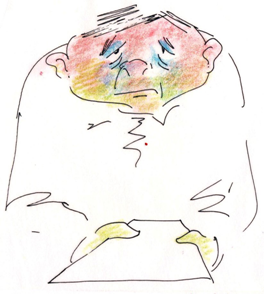
(Not pleasing to the eye.)
--1. What is the first impression your piece gives? Does your
product look cheap or worthwhile? Is there too much of it, or is it just
right? Is it forbidding or easy to get into?
--2. Does it use
techniques to help the user to access material? Can you see your
product from the recipient/user's point of view? Its shape (i.e.,
design) must encourage whatever will enable the user to derive the
greatest benefit most vividly and as fast as possible. It must
complement the structure and content of the writing.
--3. Is it
planned as an object that is right for its use? If not, it'll be
rejected. Prioritize findability, recognizability, durability, shelf
life, legibility (printing quality).
--4. Does its typography
transmit instant information? Use headlines to define the subject
matter at immediate glance. Text is to be studied and pondered slowly.
--5.
Does its typography clarify meaning? Exploiting type's
flexibility to pop up clues that reveal the structure shortcuts the slow
drudgery of reading.
--6. Create a handsome product. Good
image attracts functionally and with purpose. It demeans its potential
if it is relegated to superficial cosmetics.
--7. Make it look
valuable. Space focuses attention to what is displayed in it. When
the object is surrounded by generous space, its value increases, like a
jewel demonstrated to the buyer on a velvet cushion.
Is your
piece literature or documentation?
Literature is for
reading by a reader. The format is predicated on the way the writing
is structured. Typically, it is a narrative flow the reader starts
reading at its beginning and expects to follow to the end.
Documentation
is for referencing by a user. Technical, factual, instructional
materials are segmented into discrete info-units. The user is normally
searching only for limited information at any one time. Their sequence
is therefore less critical than:
--1. Immediate findability
(i.e., typographic clarity in the document as a whole).
--2. Immediate
comprehension (i.e., typographic clarity in each segment).
Serviceability
is the prime purpose of all publishing, whatever its platform. Its needs
vary according to what you need to say, but practicability is the
touchstone of its effectiveness. The demands of functional excellence
outweigh all other demands. The arrogant assumption has always been that
it doesn't matter how we present the stuff; "they" need it so they'll
plough through anything to get it. Wrong. Not anymore. Just being
pleasing to the eye is eyewash.
Jan V. White is author of the
classic Editing by Design, Third Edition (Allworth Press,
available on Amazon). Eight of his other books are now in the public
domain and available for free at http://openlibrary.org/books.
He may be reached at janvw2@aol.com.
Add
your comment.