
Five Internal Obstacles to Covid-Slump Recovery
Posted on Friday, July 31, 2020 at 3:48 AM
Are you steering your publication toward post-Covid success, or are
you standing in your own way?
By William Dunkerley
Today's
pandemic has hit different magazines to different degrees. Some
publications have actually done well in holding their own. They are the
lucky ones. Typically they serve a market segment that doesn't involve
people congregating.
Other publishers may be feeling that their
luck has run out. Some have seen drops in ad revenue of 70 percent or
more. At the same time, magazines that enjoy audience revenue may have
seen some increases there. It seems that homebound people have turned to
reading more.
Prospects for Ad Revenue Recovery?
When
will ad revenue return to normal? There is no pat answer. The cold hard
fact is that it may not be in time to rescue your publication. Recovery
times will vary depending on which segment of the economy your
publication serves.
McKinsey Global Institute and Oxford
Economics produced a model that shows how various industries are
expected to recover. It addresses the respective contributions to GDP,
not ad spending. But it does give clues that can inform the expectations
of publishers in the corresponding industries. Here's a graphic
presentation of the results: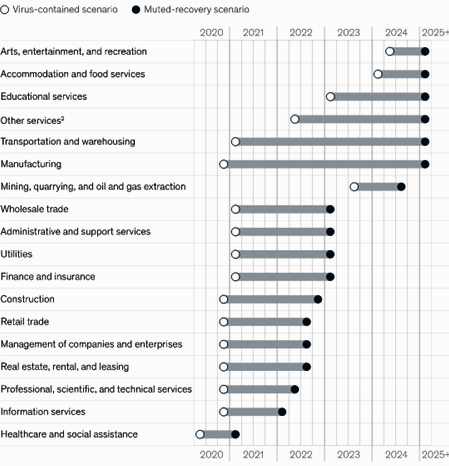
Estimated times for contribution to GDP to rebound to 2019 levels, shown by industry.
The white circles show the point of return to 2019 levels of
contribution to GDP given a virus-contained scenario. The black circles
show haw far the rebound may take in a muted-recovery scenario.
Consider
this as one input as you gauge expectations for recovery in your ad
market. The graph hints at external obstacles you may face, but there
are internal obstacles as well.
The Five Internal Obstacles
1.
The Death Spiral. Group M concisely articulated this one. It
focused on print media, including publications with associated digital
content. Here's the scenario: "Print publications in most markets are
likely to go through a vicious cycle of [1] disinvestment in content due
to an absence of advertiser support that [2] will then lead to
disengaged consumers and advertisers who are, in turn, [3] further
disengaged themselves." That's a pretty bleak and dangerous series of
events. We concur that this scenario may very well be the fate of some
publications.
2. The Broken-Down Business Model. The
business plans of some magazines are just not geared toward doing
business effectively. Presenting advertisers with an audience poised to
buy is a key business objective for any magazine that depends on ad
revenue. All too often, though, magazines are doing a poor job at that.
There is a mismatch between the sellers and the buyers; audiences have
not been developed with sufficient emphasis on finding buyers for the
advertisers. In good economic conditions this mismatch may not be a
paramount problem -- magazines can skate by doing an inefficient job.
But when an economic downturn occurs, these magazines find themselves in
trouble. Advertisers seeing weak results from their advertising drop
books that are poor performers.
3. The Inadequate Prospect
List. Many magazine ad sales efforts are almost entirely focused on
servicing existing accounts. That may be an adequate approach when times
are good, but it leaves you with nowhere to go when those accounts start
cutting back or canceling schedules. How up to date is your prospect
list? Indeed, do you even have one worth mentioning? A good prospect
list is one that is constantly being added to and constantly worked for
picking up new accounts. A deficient prospect list can be a killer in
times like these.
4. The Sales Force Stuck in a Rut.
Magazines that live by servicing existing accounts tend to have
salespeople that spend their time working those accounts. Some of them
are little more than order takers. They may not be up to the challenge
of aggressive selling. Indeed, they may lack the skills for that. They
are in a rut. Sometimes magazine management accidentally incentivizes
maladaptive behaviors. If financial rewards are too heavily focused on
total sales, it's an invitation for salespeople to avoid building the
prospect list and making cold calls. Actually, some of the list building
can be done by an advertising assistant working under the guidance of a
salesperson. An assistant can also help in qualifying the prospects.
That needs to be done with care, however, so as not to dampen the new
prospect's receptivity to a future sales call. We'll have more on this
in a future issue.
5. The Lack of Business Agility. A
rigid organization will be in great danger in the face of changing
circumstances. We're seeing changing circumstances right now. Publishers
must be willing to depart from past procedures and strategies. Now is
the time to match what you are doing to today's reality. What's more,
you need to roll with emerging change since Covid-induced economic
effects are still unfolding and will continue to do so for some time.
Free yourself to experiment and develop new strategies. Use positive
leadership techniques to bring your staff along in this. It will be
important for them to see and share your vision. Be patient, though.
Change is never easy for a lot of people. Some will see it as a threat
instead of an opportunity. It will be up to you to show them the
difference, and how adapting to economic and market changes will be in
their own personal interests.
William Dunkerley is principal
of William Dunkerley Publishing Consultants, www.publishinghelp.com.
Add
your comment.